
The history of Hungary processes the history of the country as well as the history of the Hungarian people and thus, could be seen as old as ten thousand years old. While there is less written historical evidence on the earliest ages (i.e. on the prehistory) and hence, on the origin of Hungarians, the first approved date for its ´state´ history dates back to around 895 when, under the leadership of Árpád, Hungarian tribes occupied the Carpathian Basin and laid the first funds for the Hungarian Kingdom. Current research is trying to build new knowledge on the origin of Hungarians based among others on archeological findings, linguistic, ethnographical studies, and genetics.
Thus, the first and foremost known dynasty in Hungary is the dynasty of Árpád, and it is considered the grounding father of Hungarians. Following the nomadic senior succession order, Géza fejedelem (= prince) inherited the power in 972, who in turn was followed by his son, ´Saint´ Stephen (Szent István király). ´Saint´ Stephen is known as the first Christian king of Hungary and the official founding father of the state of Hungary. Other important and well-known historical periods include the 150 years long Turkish occupation, the Habsburg Monarchy, and the double monarchy, World War I (WWI) followed by the ´Aster Revolution´ (Őszirózsás forradalom) and Trianon, and the Second World War (WWII) resulting in communism. The 1956 revolution aimed to put an end to communism. However, the communist era did not end before 1989.
Pre-history
The prehistory of Hungary and Hungarians is still up for debate. However, some written documents point out some facts and direct the view and work of researchers in some specific direction. Here you can find out what we know and what should be paid more attention to.
Medieval Hungary (1000-1526)
This part of Hungarian history can be divided into two main eras; the Early Middle Ages (1000-1301), when the Árpádian kings (1000-1301) ruled, and the country was weighed down by Mongol invasions (1241-42). Then, in the Late Middle Ages (1301-1526) when as a result of power struggles between the nobles and the various elected kings of Hungary (1301-1526), economic and political chaos reigned. However, the best-known part of this period was the Ottoman attacks (1390-1526), followed by the Ottoman occupation of Hungary (1545-1686).
Early Modern Period (1526-1914)
With regard to that the early modern period stretches through a broad time period and covers a vast range of topics that had ponderous effects on Hungary, decision was made to divide it into two parts. These two parts include and reflect incidents such as a brief description of the Ottoman occupation and life in Royal Hungary in opposition to life in Ottoman-dominated areas, the ages of Enlightenment which resulted in the Anti-Habsburg uprisings (Early Modern Period I 1526-1711) and later also in reforms, and then the 1848 Revolution (1825-1914) which are described in Early Modern Period II (1825-1914).
Although these events provided growing ground and were the precursors for World War I, the 1956 revolution, and also to World War II, yet these latter will be processed under the title ´Modern Period´ together with more recent events.
Modern Period (1914-1989)
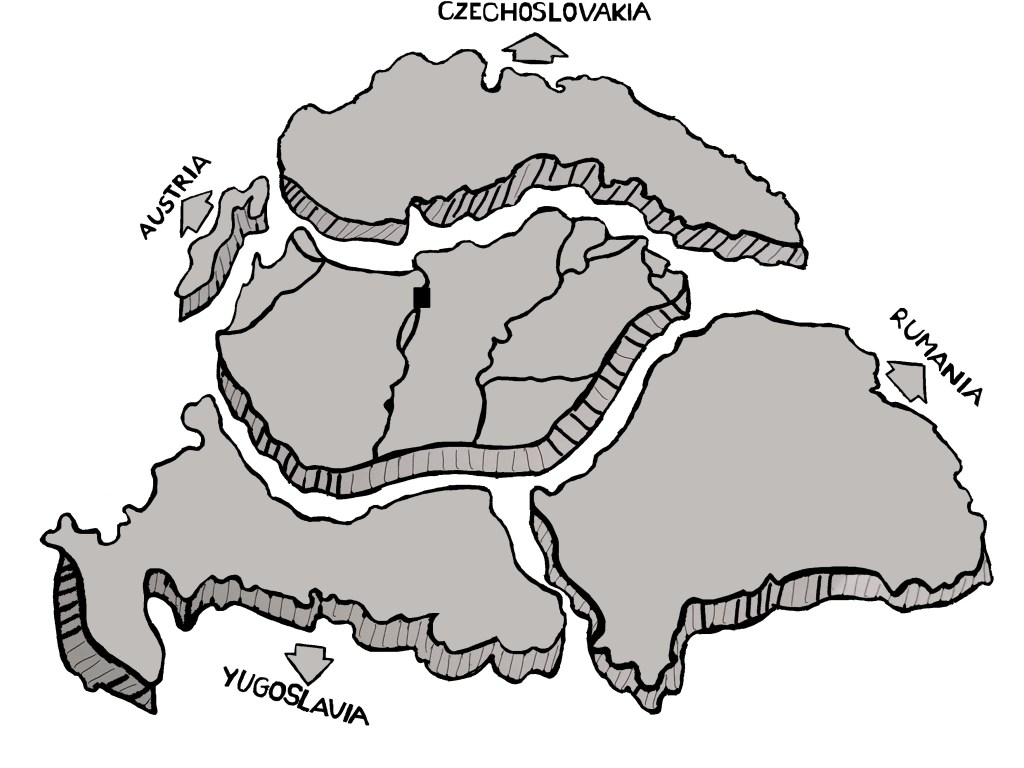
World War I (1914-1918) and the Interwar period (1918-1939); both of which you can find under Modern period I (1914-1939); as well as World War II (1939-1945) and the Post-war Communist period (1945-1989), was overwhelming in the history of Hungary. These events had a great impact and far-reaching consequences on the development of the country and on the life of Hungarians. (You find further information on World War II under Modern period II, 1939-1945.) Hungary suffered not only from declining economics but also from the loss of territories and populace, and hence, even from damaged identity and dignity. One oppressing state after another replaced each other, and the repressions and corruptions of the communist era (Modern period III, 1946-1989) left deep wounds in the heart of the nation, and changes for relief were not even on the horizon.
After 1989
*
Written by Gertrúd Windberg 2023, Sundbyberg
Before using this website please read carefully its ´Terms of use´ and ´General Data Privacy Statement´ (Code of conduct).
Copyright © 2020-2030 – Gertrúd Windberg All rights reserved
 Kingdom of HUNGARY
You must be logged in to post a comment.